
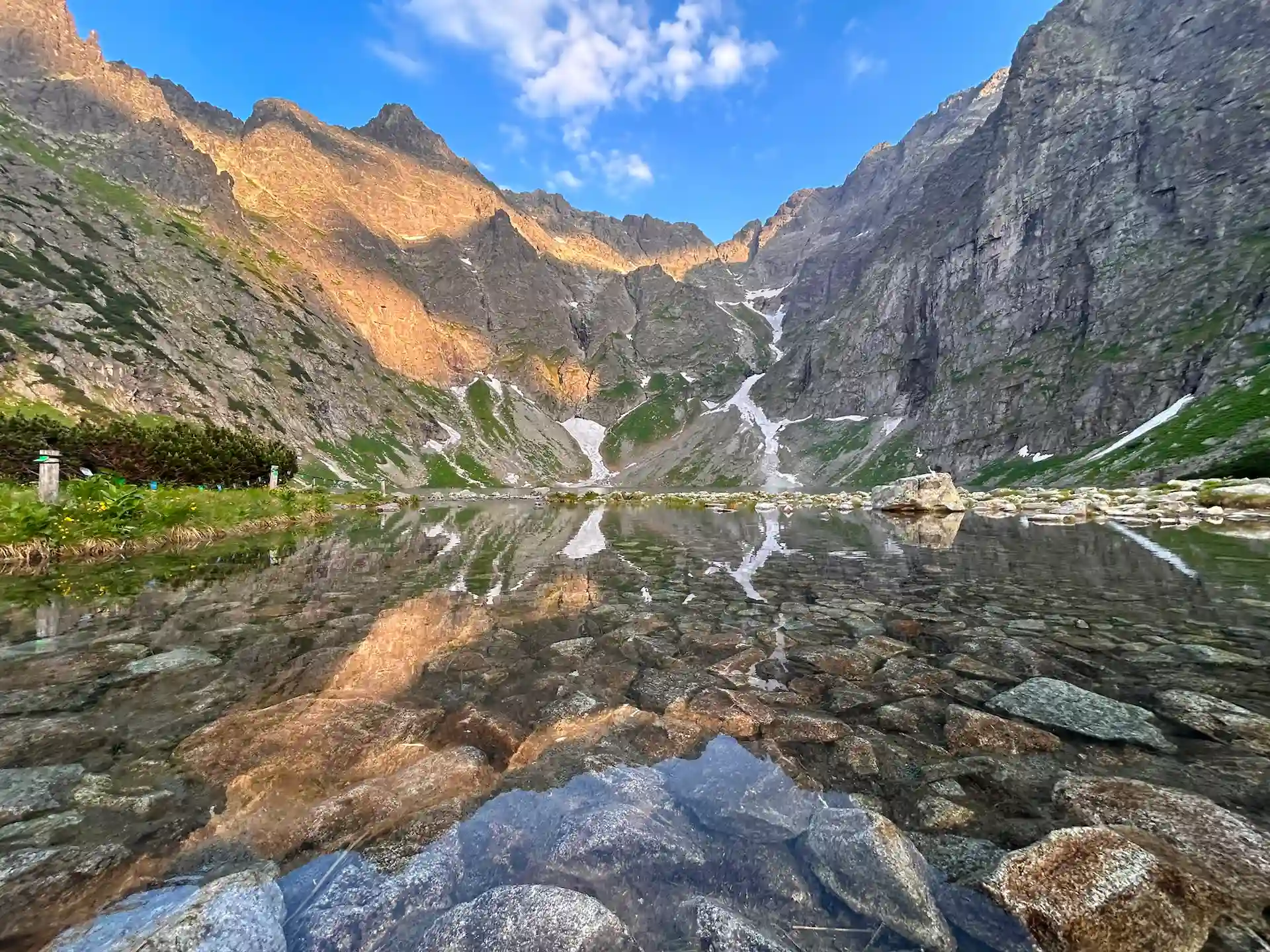
Rysy (2499 m) is the highest peak in Poland, and for most people it is the most serious mountain day they have behind them. At TatrActive we guide the climb from the Morskie Oko side: we start from Palenica Białczańska at about 5:00 and are back around 17:00-18:00, with a helmet, harness and lanyard with a shock absorber included, in a group of up to 5 people. Here is what the day looks like, and where the difficulty really lies.
Why we start at 5:00
Climbing Rysy is a long day, well over a dozen hours from car park to car park. An early start gives you three things at once: time in hand before the afternoon storms, fewer people on the trail, and a calm pace instead of racing the dark. We usually finish the descent from Rysy around 17:00-18:00.
Hardly anyone complains about the hour. Quite a few people tell us in the morning that they could not sleep from excitement - for many, climbing Rysy is something they have wanted to do for years.
What the day looks like
Departure at 05:00
The hours are rough guidance - the walk can take longer or shorter. Assume you will be down late in the evening. Do not plan anything else for that day after the tour.
- ascent05:00Palenica Bialczanska
We meet at the car park for a briefing and a kit check. From here it is about two hours up the Rybi Potok valley.
- ascent06:45Morskie Oko1395 m a.s.l.+1 h 45 from departure
A short break to top up water. We tell you about the 1902 case - a court in Graz decided whether Morskie Oko was Polish. We walk the shore.
- ascent07:45Czarny Staw pod Rysami1583 m a.s.l.+2 h 45 from departure
The second lake, below Rysy and Mieguszowiecki Szczyt Czarny. We round it and start the steep, stony climb towards Bula.
- ascent10:00Bula pod Rysami2050 m a.s.l.+5 h from departure
You put on a helmet, harness and lanyard. A technical briefing: how to move on rock and how to secure yourself on the chains. Above Bula a very steep rock slope begins.
- summit12:00Rysy2499 m a.s.l.+7 h from departure
The highest point in Poland - the Slovak Tatras, Krywan and Gerlach on the horizon, Morskie Oko far below. We stay 45 minutes and start down at 12:45.
- descent14:15Bula pod Rysami2050 m a.s.l.+9 h 15 from departure
We go down exactly the same way. The rock is behind us and the safety kit comes off.
- descent16:00Czarny Staw pod Rysami1583 m a.s.l.+11 h from departure
We come back down to the lakes the same way.
- descent16:45Morskie Oko1395 m a.s.l.+11 h 45 from departure
A stop at the hut - toilets, something warm, a breather before the last stretch.
- descent18:30Palenica Bialczanska+13 h 30 from departure
End of the day. The last stretch takes longer than in the morning.
The first part of the day is easier than you think
The walk up to Morskie Oko takes us 1.5 to 2 hours and runs mostly along a tarmac road through Dolina Białki and Dolina Rybiego Potoku. We stop for first breakfast at the mountain hut. Even here we watch the pace: on easy tarmac it is easy to walk too fast and spend energy you will want higher up. It is also the part of the day when you can talk easily and look around.
From there it is another 40-60 minutes up to Czarny Staw pod Rysami. At the lake there is a moment for photos and a drink of water, and that is practically the last point where the route still feels like a walk.
We put the gear on earlier than you expect
You get your own set of gear from us at the start, at Palenica Białczańska: a helmet, a climbing harness and a lanyard with a shock absorber. You do not need to bring anything or rent it separately with a deposit and a return the next day.
We put helmets on just above Czarny Staw, before the ground gets really steep. The reason is simple: above that point stones can come down from above, and sometimes so can things other people drop - a water bottle or a flask can fall several hundred metres. A helmet put on at the right moment is worth far more than a helmet in your backpack.
On the way we stop at a well known boulder with a view of Czarny Staw and Morskie Oko at the same time. This is usually the first point where you really feel the height and the space, and it is where everybody pauses.
The last long stop is at Bula pod Rysami (2054 m). That is where we eat and where we go through the gear: how to fit the harness, how to use the lanyard with a shock absorber, how to move in it. We do this on calm, flat ground, and not when the difficulty is already in front of your nose.
I really recommend Łukasz as a guide - he tells you a lot about the mountains and does it well, he looks after the group and above all after safety. Very happy with the Rysy trip.
The biggest danger on Rysy is other people
This is the sentence I repeat to every group:
The biggest danger when climbing Rysy is other people.
Rysy is the highest peak in Poland, so the trail gets busy, and the climb is narrow and steep. People are going up and coming down at the same time, in places where passing takes care. Part of our job is managing traffic on the trail - we decide where and when we pass others, so that nobody from outside the group creates a risk for us. On top of that there is the real danger of falling stones.
You cannot buy this separately, and you cannot make up for it with good fitness. Walking alone, you simply have nobody managing it.
The final climb: the ridge and the chains
Higher up we come out onto the ridge near Turnia nad Grzędą (2472 m) and from there cross to Przełączka pod Rysami (2469 m). This is the exciting part: steep and secured with chains. The final climb to the summit itself also follows chains.
The top of Rysy is usually crowded. There are a lot of people, and you sometimes have to wait a moment for a summit photo. If we have the time and the energy, we also go up to the Slovak summit, which is quieter and, strictly speaking, higher at 2503 m.
My son and I climbed Rysy with our guide Karolina. Expert care, with the emphasis on safety and on how comfortable you feel. Her knowledge of the Tatras is impressive. Recommended!
The descent is harder than the climb
This surprises most people. We go down the same way, but the descent usually causes more trouble than the climb: you cannot see the steps as well, you are already tired, and your legs start to hurt. Your attention has to stay with you right to the end, even though the summit is already behind you.
There is another side to the same section: from up there the views really are stunning. Morskie Oko and Czarny Staw seen from that height are the reason people come back.
We usually finish the descent from Rysy around 17:00-18:00, and then there is the calm walk back past Morskie Oko to Palenica.
We talk along the way
Climbing Rysy is not a whole day in silence. We talk about the history of these places, the topography, the wildlife, the old mining and metalworking below the Tatras, the first ascents of the surrounding peaks and what to do in a storm. Mostly we talk about whatever you ask us, and there is rarely a shortage of questions.
We turn back when we have to, and that is part of the service
We do turn back from Rysy sometimes, and we treat it as a normal part of the job rather than a failure. The reasons vary: an approaching storm, fitness that will not carry someone further, exposure that turned out to be too much psychologically, a pace that is too slow, or rain and getting cold.
It is a decision almost nobody makes in time when walking alone, because the summit is close, because the day would be wasted, because it will probably be fine. A guide makes that call earlier, and with a cool head.
Who Rysy is for
It is for you if: you are fit and walk in the mountains regularly; exposure does not freeze you; you accept a 5:00 start and a long day.
It is not for you if: this would be your first trip in the High Tatras; you have a strong fear of heights; you have knee problems, because the descent is long and hard on them; you could not accept a change of plan if the forecast is bad. The guide always makes the decision to turn back.
If you already have Rysy behind you and want something harder technically, the next step is stage I of Orla Perć.
What is included
- A helmet, harness and lanyard with a shock absorber - collected at Palenica Białczańska.
- Teaching on the ground: how to fit the gear, how to protect yourself, how to move along chains.
- Managing traffic on the trail in the busiest places.
- A group of up to 5 people plus the guide.
- Guiding in Polish or English.
Frequently asked questions
How long does the climb to Rysy from Palenica Białczańska take?
It is a full day. We start at about 5:00 and usually finish the descent from Rysy around 17:00-18:00. It is 1.5-2 hours up to Morskie Oko, and another 40-60 minutes from there to Czarny Staw.
Do I need gear for Rysy?
On the secured sections we use a helmet, a harness and a lanyard with a shock absorber. With us you get the full set at the start, included in the price.
Is Rysy difficult?
Technically it is a trail secured with chains, with no climbing involved. The difficulty comes from the length of the day, the steepness and the crowds - and from the descent, which tires you more than the climb.
Do we go up the Slovak summit?
If there is time and energy, yes. It is quieter than the Polish summit and, strictly speaking, it is the higher one at 2503 m.
How many people are in the group?
Up to 5 plus the guide.
Coming with us?
Check the available dates and book your spot online - no phone calls, no waiting for a reply.
Author
Karolina Gac
Licensed Class III Tatra mountain guide, ski instructor and co-founder of TatrActive. In summer she leads trekking trips, and in winter ski touring too. She wants people to come back not only with beautiful photos, but with the feeling that they truly experienced the mountains.
Related posts
Prezent dla miłośnika gór: dzień w Tatrach, którego nie kupisz w sklepie
Co podarować komuś, kto kocha góry i ma już wszystko? Dzień w Tatrach z przewodnikiem: jak działa voucher, jaką trasę wybrać i czy obdarowany da radę.
Orla Perć stage I - Zawrat to Skrajny Granat with a guide
Stage I of Orla Perć, Zawrat to Skrajny Granat, in one day with a guide. What the day looks like, where it gets hardest, and what is included. Up to 4 people per group.