
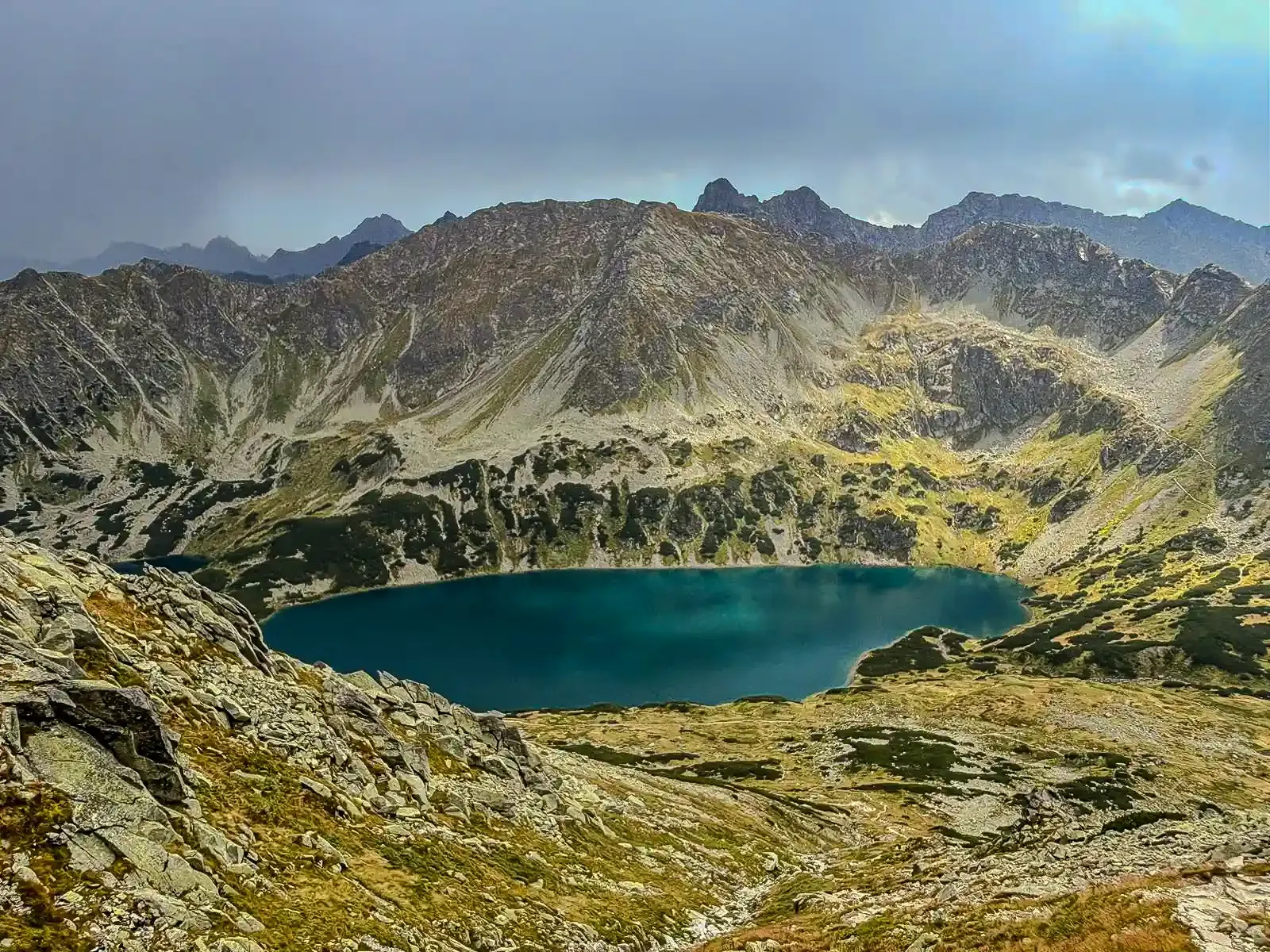
Stage I of Orla Perć is the Zawrat to Skrajny Granat section. At TatrActive we guide it on Saturdays as a single day: we start from Kuźnice at about 5:00, you are on your feet for 12-14 hours, and a helmet, harness and lanyard with a shock absorber are included, in a group of up to 4 people. Stage II, from Skrajny Granat to Krzyżne, runs on Sundays. You can do one of them or both over a weekend.
Why one stage, and not the whole of Orla Perć at once
The full Orla Perć, from Zawrat to Krzyżne, is 4.3 km of trail and about 6.5 hours of walking along it. Despite the name and the photographs, Orla Perć is not a ridge trail - for most of its length it traverses the slopes below the ridge. Add the approach and the descent and the day grows to 15-17 hours. We do not encourage anyone to take that option. You come back in the evening, exactly when summer storms tend to arrive in the Tatras and when tiredness is at its worst - and it is tiredness in the second half of the day that lies behind most accidents on this trail.
So we split the trail across two days: Saturday is stage I (Zawrat to Skrajny Granat), Sunday is stage II (Skrajny Granat to Krzyżne). Each stage is a separate trip and you can book just one. The split is not official and is not marked by the national park. It is simply the shape of a day you can walk with time to spare.
What the day looks like
Departure at 05:00
The hours are rough guidance - the walk can take longer or shorter. Assume you will be down late in the evening. Do not plan anything else for that day after the tour.
- ascent05:00Kuznice
Start. We hand out the gear, talk the route through and set off.
- ascent06:45Hala Gasienicowa+1 h 45 from departure
The climb from Kuznice is behind us. A quick breakfast and we head on towards Zawrat.
- ascent10:00Zawrat+5 h from departure
This is where Orla Perc starts. We rest for a moment and the real fun begins 😉
- summit13:00Kozi Wierch+8 h from departure
The highest peak lying entirely within Poland. You take in the panorama from the top.
- descent15:00Skrajny Granat+10 h from departure
This summit is where today's Orla Perc ends. We start going down.
- descent16:30Murowaniec hut+11 h 30 from departure
The main part of the route is behind us. We rest before the walk down to Kuznice.
- descent18:30Back at Kuznice+13 h 30 from departure
End of the trip. Your legs are jelly, but the glory is forever!
What the day looks like with us
A 5:00 start sounds harsh, but hardly anyone complains about it. Quite a few people tell us in the morning that they could not sleep from excitement - for many, this section or Rysy is something they have wanted to do for years.
We start around 5:00 in Kuźnice, but the first thing we do is talk, not walk. We show you the map: where we are going, how long it takes, and where it gets serious. We also go through the escape routes, the ways down if the weather breaks. This is the part of planning people usually skip when they walk alone, and it decides whether a bad forecast halfway through the day is a problem or just a change of plan.
In Kuźnice you also get your own set of gear: a helmet, a climbing harness and a lanyard with a shock absorber. You do not need to bring anything or rent it separately with a deposit and a return the next day. You hand it back in the same place after the descent.
Then comes a long, steady climb to Hala Gąsienicowa and the first proper food break. On a day this long, a proper meal is not a treat, it is fuel and the foundation of your safety.
We put the gear on before you need it
This is the difference you will not see in trail descriptions. We put helmets on lower down than most people expect, above Czarny Staw Gąsienicowy, because that is where the ground begins that sends stones down from above. We explain why exactly there, and we show you how to read the ground: where a falling stone can come from, and why you never stand directly below the group above you.
We put on the harness and lanyard above Zmarzły Staw, while the ground is still flat - not on a narrow ledge above a drop, where it gets rushed and done badly. That is also where we show you how to move in it and how to protect yourself. The rest happens on the climb to Zawrat itself: the guide watches how you move on steep ground, sets the pace, and tells you at specific spots when to reach for the chain and when not to clip in just there.
On Zawrat (2159 m) we take the last long break. The view opens onto Dolina Pięciu Stawów Polskich, the Valley of Five Lakes, and this is the moment when we tell the group: right, this is what we came for. 😉 Everything before this was the approach.
Łukasz is a great guide with passion, experience and knowledge. He teaches you the topography of the Tatras, how to read the weather and how to move in difficult ground. Recommended!
We talk along the way
Walking this section is not a whole day in silence. Along the way we talk about the history of these places, the topography, the wildlife, the old mining and metalworking below the Tatras, the first ascents of individual peaks and what to do in a storm. Mostly we talk about whatever you ask us, and there are usually plenty of questions.
That is the second thing you get alongside safety: you come back knowing what you were looking at, not just with a list of summits ticked off.
Where it is hardest, and where it is most nerve-racking
On the way we pass Chłopek, a distinctive rock needle that almost everyone recognises from photos online before they arrive. People stop and take the same picture everyone takes: the one where you pretend to hold it up - and no, we will not be judging your creativity. 📸
The best known spot on the route is still the metal ladder dropping onto Kozia Przełęcz. It is the one that circulates online and the one people worry about most before the trip. The reaction afterwards is almost always the same:
It looks scarier in the photos than it really is
In season you sometimes have to wait at the ladder. The Zawrat - Kozia Przełęcz section is one way only under national park rules, because passing another person on the ladder is impossible. That is one of the reasons we start at 5:00. The wait is not wasted: the spot is relatively safe, so it becomes the perfect moment for a cup of tea, a chocolate bar and a check that your knees still remember what they are for. 🍫
The hardest part technically is not the ladder, though, but the section from Kozia Przełęcz to Kozi Wierch. The ground becomes genuinely precipitous, and in a few places the slabs have no chains at all. For most people this is a surprise: you have to trust your soles and the friction, because there is very little for your fingers. On wet rock, with a slippery sole, it becomes genuinely dangerous - and this is one of those moments where somebody has to judge whether you go there at all in the current conditions. That is where we move slowest, and where having us with you counts for most.
The most nerve-racking place of the whole day is the descent from Kozie Czuby to Kozia Przełęcz Wyżnia. There are few good steps, and the ones that exist hide under your feet. This is where we most often hear from our clients:
I'm glad you're here with us
Beyond that we reach Kozi Wierch (2291 m), the highest summit lying entirely on the Polish side of the Tatras, and the main difficulties end. We usually ask the group about the emotions there, and the answer is nearly always that the last stretch before the top was genuinely demanding. What remains is the three Granaty peaks and one last strong moment, the well known step over the drop, before Skrajny Granat (2225 m), the end of stage I.
Karolina is a wonderful guide, full of passion. Under her care I had an incredible experience on Orla Perć - I will remember that day for a long time!
One thing said plainly: in the Granaty area, on the section between Zadni Granat and Pośredni Granat, there have been fatal accidents in recent years. We write about it directly, because this is not a place for marketing.
The descent, or the moment your legs go soft
The most underrated part of the day is the descent from Skrajny Granat. By then you have been on your feet for over a dozen hours, your legs hurt, and the trail down is not a gentle path. It is quite steep. You walk it without using your hands, apart from one place with a chain, and that is exactly when legs tend to go soft.
You have to stay focused right to the end. This is the moment when the guide watches over people precisely when they stop watching over themselves. "Orla Perć is finished, so the hard part is finished" is one of the more common mistakes on this route. Only at Hala Gąsienicowa and the Murowaniec hut can you sit down and get some strength back before the walk to Kuźnice.
We turn back when we have to, and that is part of the service
We do turn back sometimes, and we treat it as a normal part of the job rather than a failure. The reasons vary: an approaching storm, fitness that will not carry someone further, exposure that turned out to be too much psychologically, a pace that is too slow, or rain and getting cold.
It is a decision almost nobody makes in time when walking alone, because the summit is close, because the day would be wasted, because it will probably be fine. A guide makes that call earlier, and with a cool head.
Safety: numbers, not impressions
According to the TOPR mountain rescue report "Fatal accidents 2010-2019" (Marasek 2022), 21 people died on Orla Perć and its approach trails during that decade, about two a year. Across the whole documented record, from 1909 onwards, TOPR counted 122 deaths there - 101 up to 2009 and 21 between 2010 and 2019. In its report for 1909-2009 TOPR calls this area the most dangerous for tourists in the whole Tatras. The accidents are not concentrated in one place: the highest toll in that decade was in Żleb Kulczyńskiego - 5 of the 21. The Zmarzła Przełęcz Wyżnia area accounts for 4, and the Granaty peaks, the section below Krzyżne and the Kozi Wierch area for 3 each. You can find the full reports at topr.pl.
One thing we see on our own days out: accidents happen more often in the second half of the day, when legs are already tired. That is why we start at 5:00, why we do not rush, why we take up to 4 people, and why the guide always makes the decision to turn back. Not reaching the summit is not always a failure. In the same report TOPR advises plainly that this trail calls for hiring "a guide who will take care of our safety".
What is included
- A helmet, harness and lanyard with a shock absorber - collected in Kuźnice, handed back in Kuźnice.
- Teaching on the ground: how to fit the gear, how to protect yourself, where to put your feet, how to read the terrain.
- The national park entry ticket.
- A set of photos from the route, taken by the guide along the way.
- A group of up to 4 people plus the guide.
- Guiding in Polish or English.
Is this route for you
This is the level the route asks for. Check whether it sounds like you.
- Fitness and pace5 of 5
A dozen hours of walking is not much of a problem for you. You train regularly, you run and you hike. A trail rated at 4 hours takes you about 3 hours.
- Fear of heights5 of 5
The route has places with a drop on both sides, or traverses above a drop - you walk above a precipice. It calls for a head for heights.
- Mountain experience5 of 5
You have Tatra trails with chains behind you, for example Zawrat, Szpiglasowy Wierch or Koscielec.
Frequently asked questions
How long does stage I of Orla Perć take?
What is the difference between stage I and stage II?
Do I need my own gear?
Is Orla Perć one way only?
What is "Mała Orla Perć"?
How many people are in the group?
Coming with us?
Check the available dates and book your spot online - no phone calls, no waiting for a reply.
- Adam Marasek, Andrzej Marasek - Wypadki śmiertelne na terenie działania TOPR w latach 2010-2019 (TOPR fatal accident report, in Polish) [accessed: 06.08.2026]
- Adam Marasek, Andrzej Marasek - Wypadki śmiertelne na terenie działania TOPR w latach 1909-2009 (TOPR fatal accident report, in Polish) [accessed: 06.08.2026]

Author
Łukasz Ryłko
Licensed Class III Tatra mountain guide and co-founder of TatrActive. In summer he leads groups on Orla Perć, Rysy, Świnica and Kościelec; in winter on Czerwone Wierchy, Wołowiec and across the Western Tatras.